

The right window well cover keeps rain, snow, leaves, and pests out of the well, lets daylight reach the basement, and protects kids and pets from falling into an open well. Choosing the right one is the tricky part. Covers run from clear domes to clear, low-profile covers to metal grates built for airflow into the window well, and each style is made for a different situation.
This guide breaks down the main types of window well covers, what each does best, and the details worth checking before you buy a basement window well cover. Our goal is to help match a cover to your well, your weather, and how you use the basement.
Start With What the Cover Needs to Do
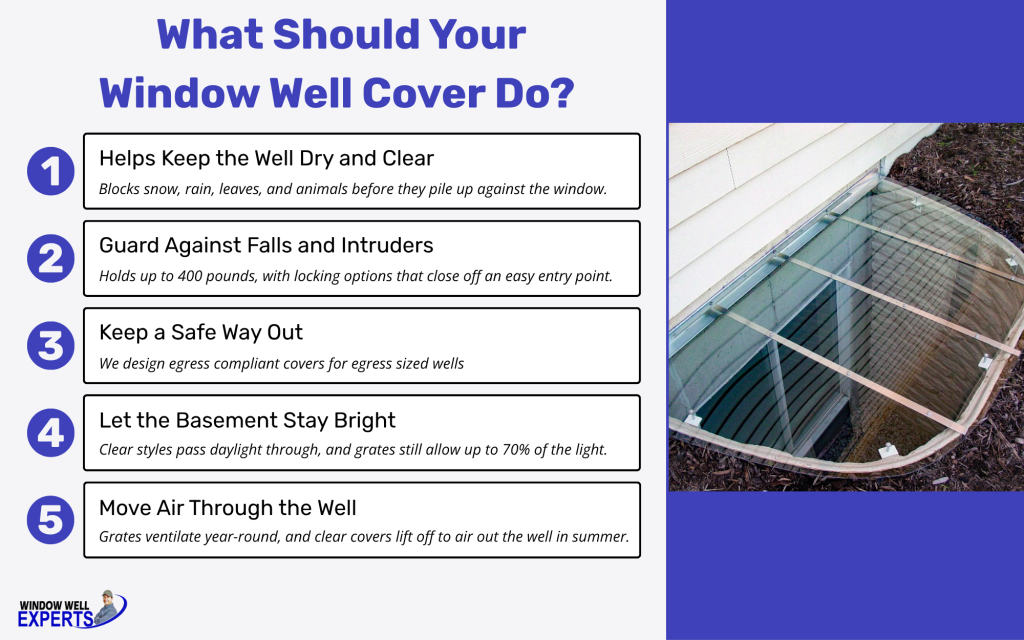
Before comparing styles, name the job. Most homeowners want one or two of these from a cover:
Keep water and debris out. A solid clear polycarbonate cover stops rain, snow, and leaves from collecting against the basement window.
Guard against falls and break-ins. A cover rated for weight support keeps kids and pets from dropping into an open well, and lockable versions help prevent unauthorized access into the house.
Emergency escape. In a bedroom or finished room, look for a window well cover that keeps your home egress code compliant if you have an egress-sized window well.
Let daylight into the basement. Clear covers let light straight through, and grates let most of the daylight reach the room below.
Keep air moving. Grates ventilate the well year-round, and a clear cover lifts off when you want to get fresh air ventilation in summer.
Does your answer point to a material and a style? If a clean, dry well is the priority, a clear cover fits. If ventilation matters more, a grate is the better place to start.
The Main Types of Window Well Covers
Window Well Experts works with clear impact-resistant polycarbonate, rust-free aluminum, and powder-coated steel. Our window well covers fit metal, composite, wood, concrete, plastic, and stone window wells. Here is how our well covers compare.
Sloped Covers
Sloped covers are clear, impact-resistant panels that let light through while shedding water away from the foundation. The up to 2” slope keeps water from pooling, and the UV treatment helps the polycarbonate stay clear instead of yellowing over the years. They suit almost any well, no matter what the window well is made of. Our Sloped covers carry a lifetime warranty and hold up to 400 pounds of weight, evenly distributed. If your window comes above the rim of the well and does not crank out into the well, we have back panels and back splashes that may help keep moisture and debris out of your well, depending on your circumstances.
Flat Covers
Flat covers are, as the name says, flat and have no active drainage. We make them with the same clear impact-resistant plastic and lifetime warranty as the sloped style, and they block leaves, debris, rain, snow, and small animals while letting daylight into the basement. The low-profile design is an economical alternative to the sloped cover.
Bubble Covers
Bubble covers are clear domes built for the most common metal wells, offered in nine standard sizes and two shapes to match semi-circle and elongated wells. The dome shape sheds rain, keeps debris from collecting, and gives clearance for any window. This heavy-duty cover holds up to hard knocks and weather, carries a lifetime warranty, and supports up to 150 pounds. An atrium or super slant cover is the better match for rectangular wells or for any type of window well that is egress-sized.
Atrium Dome Covers
Atrium domes are the tall option, made for wells where a casement or crank-out window needs room to open and for windows that rise above the top of the well. The dome protects both the well and the portion of the window above it, and it lets the window open fully for emergency escape on egress-sized wells. Some homeowners also choose an atrium for the added clearance and the clear, open view, even without a crank-out window.
Super Slant Covers
Super Slant covers combine a welded frame, mesh sides for airflow, and a UV-treated polycarbonate flip-top. The extra slope improves drainage, and the hinged escape panel opens for cleaning, maintenance, or emergency escape on egress-sized wells. This style holds up to 400 pounds and gives you easy access to the well whenever you need it.
Metal Grate Covers
Grates are the pick when airflow and strength matter. The open design keeps animals and large debris out while letting fresh air and daylight reach the basement. They come in two materials:
- Rust-free and light enough to lift by hand in an emergency
- Hold up to 400 pounds of evenly distributed weight
- Meet egress code on most metal egress wells, since they are light enough to move aside
- Diamond-shaped mesh keeps feet and paws from slipping through, unlike wide-bar grates
- 7-year warranty
- Powder-coated steel, heavier so they stay put in wind, which makes them the preferred pick for small wells and high-wind areas
- Residential grade holds up to 40 pounds per square foot; high-traffic and commercial grade holds up to 100 pounds per square foot
- Walkable for backyards, walkways, and other spots that see regular foot traffic
- 7-year warranty
Powder-coat finishes come in black, gray, or custom colors. Because a grate is open by design, rain and snow pass through, so pair one with a clear impact-resistant top cover if you want weather protection too. On larger egress wells, an optional hinged escape hatch lets the cover open from inside for a basement exit.
A Side-by-Side Look at the Common Styles
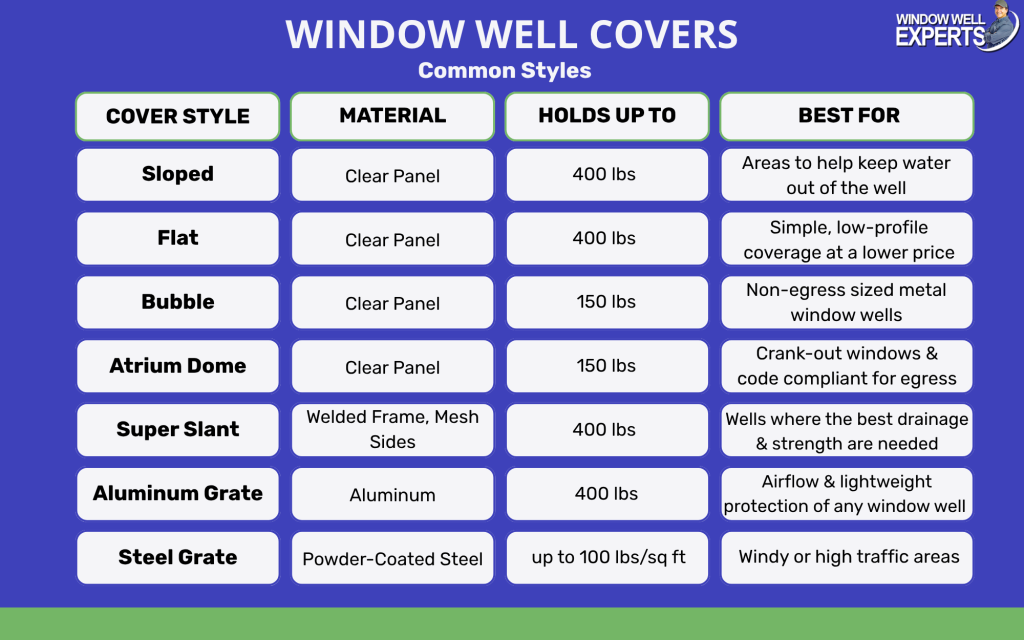
Clear covers list a total load rating, while grates durability lists a per-square-foot rating, so read the two weight columns with that difference in mind.
Five Things to Check Before You Buy a Cover
Material and Build
Thinking this through up front is the difference between buying the ideal cover once and replacing a cheap cover every couple of years, so it is worth considering what you need before choosing a cover style. Clear covers use polycarbonate, the same heavy-duty material found in safety glasses and greenhouse panels. It resists impact, lets light through, and stays clear for years when it is UV-treated, rather than yellowing the way low-grade acrylic does. When thinking about grates, rust-free aluminum will not corrode, and powder-coated steel adds a finish that guards against rust. Whichever you choose, look for a material and finish rated for your needs and the weather in your area, so the cover lasts season after season.
Weight It Can Support
A cover’s load rating tells you whether it can take an accidental step, a snow load, or a fallen branch. Sloped, flat, and super slant covers all hold up to 400 pounds. Steel and aluminum grates are rated by the square foot instead: 40 pounds on residential grades and up to 100 pounds on high-traffic and commercial grades. Bubble and atrium domes support up to 150 pounds, which covers weather and the occasional bump and to keep anyone that falls on them from harm. Choosing a cover strong enough for what your yard actually throws at it is what keeps it holding up year after year.
Weather and Drainage
Most of the country sees heavy rain or snow at some point in the year. A solid clear cover keeps that weather out of the well, and a sloped or super slant design moves water away from the foundation instead of letting it pool. For airflow in warmer months, a grate, or a grate paired with a snap-on top cover, gives you airflow you can adjust by season. Since standing water in a well is what leads to leaks and foundation trouble, matching the cover to your climate is the part that protects the house, not just the window.
Light and Airflow
Clear covers protect the well while bringing natural light into the basement. Grates trade a sealed top for constant airflow and still let up to 70% of available light through. A clear cover favors light and a grate favors airflow, so choose based on which the room needs more of.
Safety and Egress
If a basement room is a bedroom or finished living space, code likely requires a working emergency exit under the IRC emergency escape and rescue rules. Most of our covers, except Bubbles, are designed to meet egress requirements on most egress wells, and we can add an escape hatch or hinges on the largest wells so the cover meets egress codes. Whatever you pick, make sure anyone inside can still get out fast and work the egress well into your home fire escape plan. You can check your local rules against the state egress codes before you buy. However, please remember that your local building inspector has the final word considering code compliance.
Getting the Size and Fit Right
A cover only helps if it fits, so measurement comes first. Measure the opening from outside edge to outside edge, both width and depth, and record the numbers in inches. If your basement window extends above the rim of the well, note that height in inches too, since it may call for a bubble or atrium cover. Every Window Well Experts cover is custom fit and built to your well’s measurements rather than pulled off a shelf, so an odd shape or an oversized opening is not a problem.
Not sure which cover or size fits your well? A free consultation with the team sorts it out before you order, and accessories like escape hatches or top covers can be added to match how you use the space.
Picking the Right Cover for Your Home
There is no single best cover, only the best one for your well and how you use the basement. Match the style to your top goal, check the load rating and material, and confirm the cover works with your window and well type.
We have been building window well covers since 1975, and we ship them across the continental United States. Our sloped, flat, and bubble styles come with a lifetime warranty, and we make every cover in the USA to your own measurements, so it fits your well the first time. We also carry accessories like escape hatches. hinges, and top covers to match how you use the space. Send us your measurements for a free estimate, or call our team seven days a week, and we will help you choose the right cover for your home.